Why does color sudoku feel deeper than classic sudoku? Because colors don't just add visual flair — they interlock with numbers to create richer patterns, more constraints, and new solving paths that don't exist in traditional sudoku.
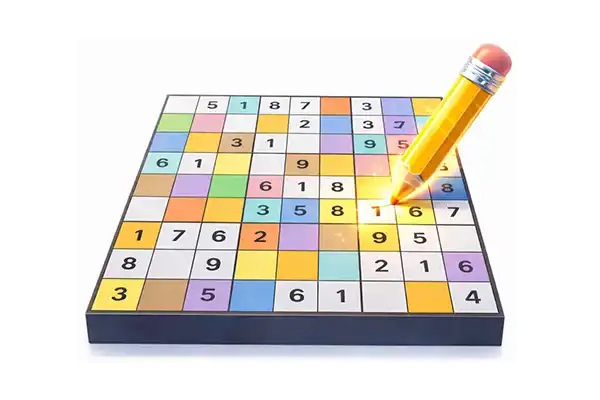
What is Intrication?
 What is Intrication?
In Suirodoku, numbers and colors are not separate dimensions — they are intricated. Each cell binds a number and a color into an inseparable pair.
This binding creates a web of interdependencies. When you place a number, you also place a color. When you deduce a color, you constrain the number.
How Sudoku Works
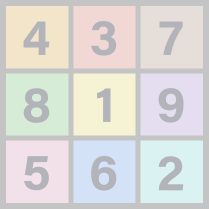 How Sudoku Works
In classic Sudoku, you think in one dimension:
- "This row needs a 5"
- "This column already has a 7"
- "This region is missing a 3"
Numbers exist independently. A "5" in row 1 is the same as a "5" in row 9.
How Suirodoku Upgrades This
 How Suirodoku Upgrades This
In Suirodoku, you think in two intricated dimensions:
- "This row needs a 5... and it's missing Yellow"
- "This column has a 7, but which color?"
- "Green needs a 3, but where can Green 3 go?"

The key insight: Every deduction about numbers gives information about colors, and vice versa. The two dimensions reinforce each other.
Practical Example
 Practical Example
Imagine you're stuck on a cell. In Sudoku, you'd only consider numbers.
In Suirodoku, you can ask:
- What numbers can go here? (Sudoku logic)
- What colors can go here? (Color constraints)
- Which number-color pairs satisfy both? (Intrication)
Often, a cell that seems to have 3 possible numbers actually has only 1 possible pair when you consider colors.
The Upgrade
 The Upgrade
Suirodoku doesn't replace Sudoku skills — it upgrades them:
- All Sudoku techniques still work
- Colors add a parallel track of deduction
- The intrication creates new solving paths
- Rainbow and Chromatic Circle become possible
You're not learning a new game. You're playing Sudoku with a 4th dimension.
Understand the Foundation
To fully grasp why color sudoku feels deeper, explore these core concepts:
- The 4th Rule Explained — the exact constraint that creates this depth
- 81 Unique Pairs — how 9×9 combinations change everything